
Lift Kit Installation — How Big Can You Go?
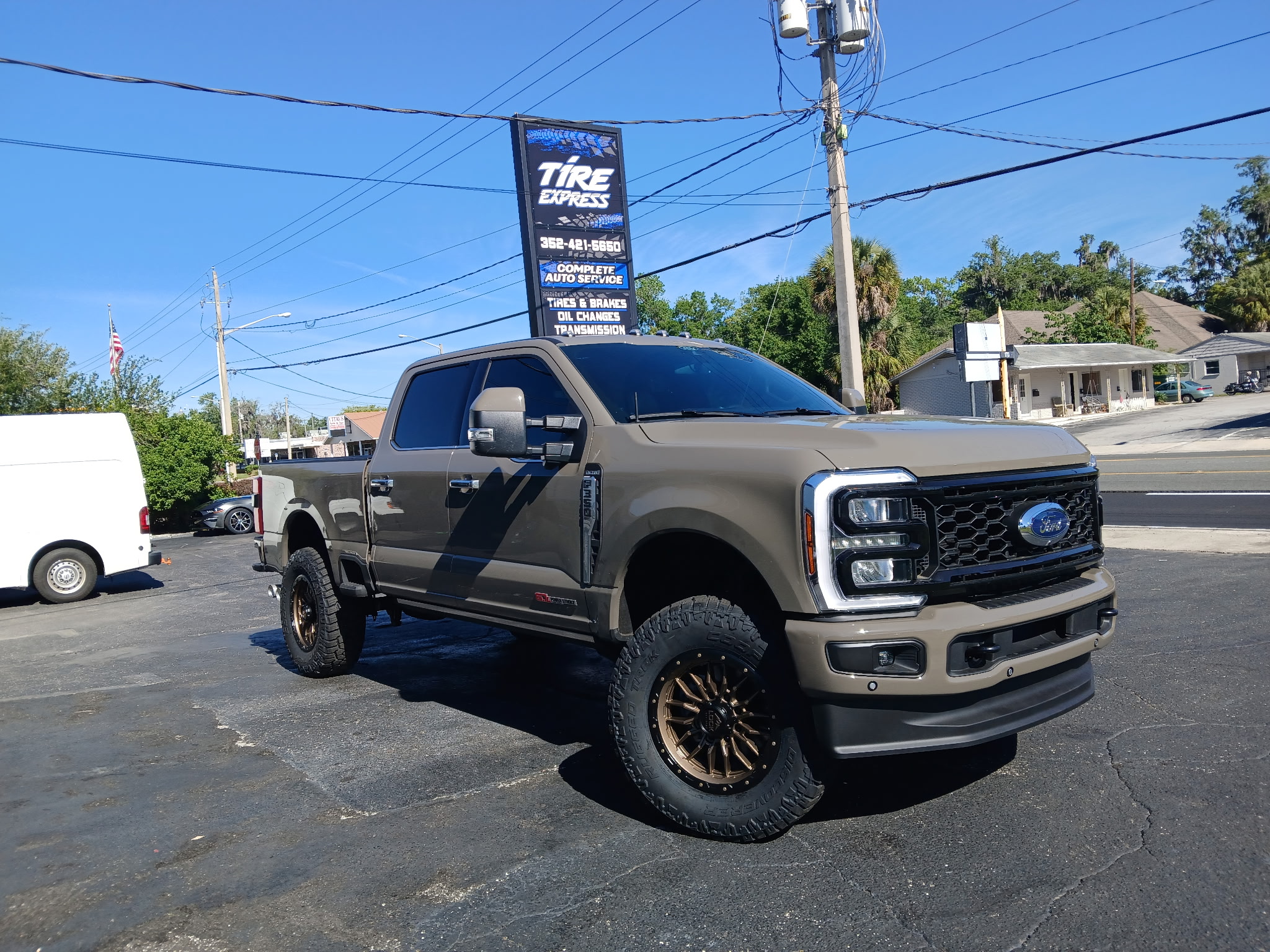
For most trucks in Ocala the sweet spot is a leveling kit or a 2–4″ lift — enough for 33s or 35s, a great stance, and a truck that still drives like a truck. Go 6″ or taller and the price of admission jumps: extended brake lines, driveshaft work, possibly regearing, and a ride that changes character. Florida doesn’t have a single “max lift” law — it regulates bumper height by vehicle weight (and most heavy trucks fall outside the table entirely). Whatever size you pick, the lift, the tires, and the alignment should happen at the same shop, on the same day. We do all three.
| Setup | Typical installed cost (2026) | Tires it opens up | What else it needs | Street-legal in FL? |
|---|---|---|---|---|
| Leveling kit (1.5–2.5″ front) | $300–$900 | Usually up to 33s | Alignment | Yes — no issues |
| 2″ lift | $500–$1,500 | 33s, some 34s | Alignment; shocks on some kits | Yes — no issues |
| 4″ lift | $2,000–$5,000 | 35s | Alignment, brake-line brackets, speedometer recalibration | Yes on virtually every truck |
| 6″+ lift | $4,000–$10,000+ | 35–38s | Alignment, extended brake lines, driveshaft/carrier work, possible regear | Usually — check bumper height on lighter trucks |
Every week somebody pulls into the shop on Silver Springs Boulevard, points at a lifted truck in the lot, and asks the same question: “How big can I go?” It’s a fair question — and the honest answer is that “as big as possible” and “as big as you should” are usually two different numbers.
At Tire Express & Complete Auto Service we install lift kits, and we also mount and balance the big rubber that goes with them — up to 38 inches and beyond. That means we see the whole picture: the kits that turn out great, the ones that got installed cheap somewhere else and wander all over I-75, and the 35s that got chewed up in 15,000 miles because nobody aligned the truck afterward. Here’s the straight version of what each lift size really gets you, what it really costs, and what Florida law actually says.
Leveling Kit vs. Lift Kit: Know Which One You Actually Need
Most trucks leave the factory with a rake — the nose sits an inch or two lower than the bed so the truck levels out under load. A leveling kit raises just the front to erase that rake. It’s the cheapest way to improve the stance, it usually clears a 33″ tire, and on a daily driver it’s often all you need.
A lift kit raises the whole truck. Entry-level kits use spacers and blocks on the factory suspension; taller kits replace knuckles, control arms, and shocks to keep the geometry correct at the new height. That distinction — spacer kit vs. full suspension kit — matters more than the number on the box, because it’s the difference between a truck that rides right and one that fights you.
What Each Size Really Means
Leveling Kit (1.5–2.5″): The Daily-Driver Move
Kills the factory rake, fits a mildly bigger tire, barely changes the ride, and doesn’t upset your fuel economy much. As of 2026 you’re typically looking at a few hundred dollars installed, plus an alignment. If your truck tows or hauls regularly, tell us first — leveling removes the rake that the factory put there for exactly that job.
2″ Lift: Mild Look, Light Trail
A modest lift all around. You get a noticeably better stance and room for 33s (34s on some trucks) without committing to real drivetrain changes. Ride quality stays close to stock if the kit is decent. This is the “dip a toe in” option, and there’s nothing wrong with it.
4″ Lift: The Classic Florida Truck
This is the most popular lift we see in Marion County, and for good reason: it clears 35s, it looks serious, and on a quality suspension kit the truck still behaves on the highway. It’s also where the supporting cast starts to matter — brake-line brackets, a speedometer recalibration for the bigger tires, and a proper alignment are part of the job, not extras. Budget realistically: kit plus install plus tires is a real number, and cheaping out on any leg of it shows.
6″ and Up: Commit or Don’t
Above six inches you’re building a different truck. Driveline angles change enough that driveshaft modifications or a carrier-bearing drop come into play, brake lines need to be extended, steering geometry needs correcting, and once you’re turning 37s or 38s, regearing the axles is often the difference between a truck that pulls and a truck that groans. Done right, a tall build is glorious. Done cheap, it’s a death wobble waiting for a bridge seam. If you’re going this big, do it once and do it right.
What Florida Law Actually Says (As of 2026)
Florida doesn’t cap lift height directly. What it regulates is bumper height, under Florida Statute 316.251, measured from the ground to the bottom of the bumper — and the limits scale with the vehicle’s net weight:
- Cars: under 2,500 lbs — 22″ front / 22″ rear max; 2,500–3,499 lbs — 24″ / 26″; 3,500 lbs and up — 27″ / 29″.
- Trucks: under 2,000 lbs net — 24″ / 26″; 2,000–3,000 lbs — 27″ / 29″; 3,000–5,000 lbs — 28″ / 30″.
Here’s the part most people don’t know: the statute applies to vehicles with a net weight under 5,000 pounds. Most three-quarter-ton and one-ton trucks weigh in over that line, which puts them outside the bumper-height table altogether. Two more practical rules still apply to everybody: your headlights have to sit no higher than 54 inches (Florida Statute 316.220), and everything on the truck — lights, mudflap coverage on commercial rigs, fender coverage for what your tires throw — still has to pass a traffic stop. A clean, professionally installed 4″ or 6″ lift on a half-ton or bigger truck is street-legal in Florida essentially every time. The trucks that get tickets are the extreme builds on light vehicles.
The Real Reason to Lift: The Tires
Nobody lifts a truck to look at more shock absorber. The lift is the opening act — the tires are the show. And this is where the plan matters, because the tire size determines the lift, not the other way around. Want 33s? A level or 2″ kit does it. Want 35s? Plan on 4″. Dreaming about 37s or 38s? That’s a 6″-plus conversation, and it should include gearing.
Big tires are also a different animal to live with. They’re heavier, they hold more rubber farther from the hub, and a small imbalance becomes a steering-wheel shimmy at 70 mph. We stock and mount lifted truck and off-road tires in Ocala up to 38 inches, balanced on Coats equipment that actually handles them — and we’ll tell you straight whether the mud-terrains you’re eyeing fit how you actually drive, or whether an all-terrain will ride quieter and last longer for the same money. Florida sun is brutal on any tire you choose — we’ve covered how Florida heat wears out tires before, and big soft-compound off-road rubber is not exempt. Ready to make it happen? Our lift kit installation service in Ocala can order the kit for you — or have the one you bought shipped straight to the shop.
Thinking about lifting your truck?
Call with your truck and the look you’re after — we’ll talk kit options, tire sizes, and a real out-the-door number. Lift, tires, and alignment in one shop, done right the first time.
CALL (352) 421-5650or just drive in — 1708 E Silver Springs Blvd, Mon–Fri 8–5 · Get DirectionsThe Step Everybody Skips: Alignment
Every lift — even a simple front leveling kit — changes your suspension geometry. Caster, camber, and toe all move, and a lifted truck running factory alignment specs will feather and cup its expensive new tires shockingly fast. A wheel alignment in Ocala the same day the lift goes on isn’t an upsell; it’s the step that protects the four most expensive pieces of the build. And with aggressive tread, plan on tire balancing and rotation every 3,000–6,000 miles — about half the normal interval — because at big-tire prices, uneven wear is real money.
Warranty and Insurance, Honestly
Two questions we get at the counter all the time:
- “Will a lift void my warranty?” Not by itself. Under the federal Magnuson-Moss Warranty Act, a dealer can’t void your whole warranty just because the truck is modified — but they can deny a claim on parts the lift affected. Lift the truck and blow a ball joint at 40,000 miles, and expect an argument. Quality parts and correct installation are your best defense.
- “Do I have to tell my insurance?” Yes. A lift and wheels are modifications, and insurers can decline to cover equipment they were never told about — or worse, use an undisclosed modification against a claim. One phone call adds the equipment to the policy; make it.
Frequently Asked Questions
How much does lift kit installation cost in Ocala?
As of 2026, ballpark installed ranges run about $300–$900 for a leveling kit, $500–$1,500 for a 2″ lift, $2,000–$5,000 for a 4″ suspension lift, and $4,000–$10,000+ once you’re at 6″ and taller — before tires. Every truck and kit is different, so call us at (352) 421-5650 with your truck and we’ll give you a real number, not a range.
What is the legal lift limit in Florida?
There isn’t a single “max lift” number. Florida regulates bumper height by vehicle weight (Statute 316.251), and vehicles with a net weight over 5,000 pounds — most heavy-duty trucks — aren’t covered by the bumper table at all. Headlights can’t sit higher than 54 inches. A professionally installed lift on a modern truck is street-legal in Florida in virtually every case.
Do I need an alignment after installing a lift kit?
Yes — every time, even for a leveling kit. Lifts change caster, camber, and toe, and skipping the alignment is the fastest way to destroy the new tires you just paid for. We do the lift, the tires, and the alignment in one visit so the geometry is right before you drive home.
Will a lift kit void my truck’s warranty?
Not automatically. The Magnuson-Moss Warranty Act stops a dealer from voiding your entire warranty over a modification, but they can deny claims on components the lift directly affected. Good parts, correct install, and paperwork are your protection.
Can I run bigger tires without a lift?
Often, yes — many trucks will take one size up from stock with no changes, and a simple leveling kit opens up 33s on most half-tons. The limit is rubbing at full steering lock and suspension compression, and that’s truck-specific. Bring it by and we’ll tell you what actually fits before you buy anything.
Ready to Go Bigger?
Whether you’re leveling a daily, planning the classic 4″-and-35s combo, or building something on 38s, do it with one shop that handles the whole job — the kit, the tires, the balancing, and the alignment. We’re the Ocala shop that actually likes your lifted truck.
Call us at (352) 421-5650 or just drive in — 1708 E Silver Springs Blvd. Tell us what you’re dreaming about and we’ll tell you what it takes to do it right.
Tire Express & Complete Auto Service is Ocala’s locally owned tire shop and auto repair center, serving Marion County and Central Florida drivers with over 50 years of combined industry experience. Veterans, active military, and first responders save 20% on every service.

Ben Bishop
Ben runs the shop on Silver Springs Blvd — the guy Ocala reviews mention by name. Straight answers, fair prices, and a standard that every vehicle leaves here done right. Meet the team.